Blog

  • The 2-Part Permanent Solution to the #1 Complaint in Real Estate

    The 2-Part Permanent Solution to the #1 Complaint in Real Estate

    What’s the #1 complaint that people have about Real Estate agents?

    LACK OF COMMUNICATION 

    “He convinced us to list with him, walked out the door with the signed contract, and that was the last we heard from him, until two weeks before the listing expired. Then, he called and pressured us to reduce the price and extend the contract. 

    If you’re feeling a pang of guilt right now – here is the 2-part permanent solution to massively improve your communication with listing clients and – MAJOR BONUS – sell more properties and make more money.

    Part 1. The Market Watch System

    Set up every listing client on an auto-notification system to notify them whenever there is a new listing, a price adjustment, a conditional sale, a firm sale, etc. Make sure they can see ALL the information on every listing, including all the pictures.

    If you’re in a large market, set up a broad set of criteria, so there are at least 50-100 active listings within a specified price range and geographical area. Your clients should be receiving relevant emails at least 2-3 times every week.

    The main objective is to provide a big picture view of the market. Your clients need to be informed whenever a new competitor enters the market, drops their price, or successfully sells.  

    The most relevant factor is the price — more so than home style, size, or age. As for the geographical area, if you need to add more surrounding communities to get your numbers up to 50-100 active listings, go ahead, even if the home styles are significantly different. 

    Use your best judgement on the price range. For example, on a $500,000 property, I might start with a range between $450,000-$600,000. Then, I would fine-tune based on the results. For example, if there were a ton of clearly superior properties between $550,000-$575,000, I might adjust my upper limit down to $575,000 because $600,000 would be overkill. 

    On the other hand, if the inventory just above $450,000 was total garbage (comparatively), I might adjust that lower limit a bit higher. 

    We don’t want our clients thinking we’re comparing their property to junk! ️

    On the contrary, we want the majority of the comparables to be superior to the subject property. I would justify this by stating, 

    “We’re priced at $500,000, but it’s important to be aware of what a buyer could purchase at a moderately higher price. If buyers can get significantly more for a price that’s only 10% higher, that’s important information for us to know.”

    Think about what information you want your client to see that will help them to make intelligent decisions. (For example, it should be obvious if a price adjustment is needed.)


    Providing your clients with the correct information allows them to make intelligent decisions.


    Here’s the most crucial advice for setting your Market Watch criteria: Take the time to look at the results and think about it from your clients’ perspective. Is this the most relevant and helpful information for them?

    The more you practice this method, the better you’ll get at it, just like any other skill.

    Setting the exact criteria takes practice, and you’ll use a different logic set for each property. If you like, give me a call (403)973-9730, and I’ll walk you through the first one or two.

    Part 2. The Weekly Client Report

    EVERY Monday morning (set this up as a recurring Appointment with Yourself), send an email report to each of your listing clients, based on the activity recorded in their ‘Market Watch’ from the previous week. 

    Here’s an abbreviated version of what you might report to your clients:

    a) New Listings — “There were two new listings over the past week. I’m not overly worried about New Listing #1 because it’s priced only slightly lower than your home, and I think it’s inferior for these reasons… 

    As for New Listing #2, this one concerns me. It’s only $10K higher than your home, and it’s newer, larger, and has these superior features… 

    I’ll be keeping a close eye on this one, but I’d be surprised if it doesn’t sell quickly.”

    b) Price Reduction — “This listing dropped its price by $20K, making it much more competitive. I’ll be watching this one, also.”

    c) Sold Listings — “These listings sold, and in my opinion, here are the reasons why…” 

    (Don’t worry. At least 99% of the time, there’s an easily explainable reason. It’s bigger. It’s newer. It’s less money. It has these features that yours doesn’t have, etc. 1% of the time, you might need to dig a little deeper and craft a more creative response.)

    d) Conclude with an honest summary (what you truly believe). For example, 

    “Based on this information and the current activity we’re getting, I’m a bit worried that we may have been overly optimistic on our list price. I’m not suggesting that we make an immediate price adjustment, but if we don’t get any strong activity before the end of the week, this might be something we need to discuss.”

    Why go to the trouble of writing this report every week? ‍♀️

    Part one of this two-part solution means that your clients automatically receive the information on each new listing, price adjustment, and sale. But, they have NOT received your professional interpretation about what each new development might mean to them. 

    Your clients will feel more informed and cared for (by you). After all, they’ve got an expert watching the market on their behalf.

    At the same time, you are forcing yourself to closely monitor what is happening and what advice you should be giving to your clients. This is a good enough reason on its own!

    Ultimately implementing this 2-part strategy means more sales, happier clients, and more referrals.


  • Four Simple Rules to Juggle Between Being a Rapid Responder and Getting Stuff Done

    Four Simple Rules to Juggle Between Being a Rapid Responder and Getting Stuff Done

    I once called a REALTOR® (let’s call him Joe Sloe) and got this recording, ”Hi, this is Joe Sloe. Please leave me a message, and I’ll return your call within two business days.”

    Hahahah! Can you imagine?

    Joe Sloe is long gone from the industry, by the way. Gosh, I wonder why!

    In this day and age, people expect you to be a rapid responder. They’re sure as heck not going to wait around for two days to hear back from you.

    The opposite of Joe Sloe is Desperate Dan. He’s the guy who answers his phone on the first ring in the middle of a business meeting, quickly realizes you’re not a hot prospect, and tells you in a snarky voice, “Hey, I’m in the middle of a meeting. Can I call you back?”

    As if you were the rude one for interrupting his meeting.

    Desperate Dan prides himself on being a rapid responder. His phone is constantly going off with alerts for emails, text messages, Facebook, and 17 other Apps, every one of which he checks immediately as if his life depended on it.

    But Desperate Dan has a serious problem. He’s 100% distracted 100% of the time. He can’t even make it through a meal with his wife and kids without checking his phone. How sad is that?

    Dan is also completely unorganized and never seems to make any progress on his giant pile of To-Dos. 

    Maybe that’s why Dan is so Desperate (?).


    Here’s my message to you.

    Don’t be Joe Sloe, but don’t be Desperate Dan, either.

    Do I think you should be a rapid responder? Certainly! But within certain limitations that support your overall productivity. ‍

    Here are a few simple rules that I follow. Perhaps they will inspire you to consider designing your own set of personal productivity rules:

    Rule #1 – When I’m in any scheduled meeting, including an Appointment with Myself, my phone is OFF. 

    Turning my phone off for one hour is completely harmless to my business. On the contrary, it’s the best thing to minimize distractions when I want to get stuff done. The only exception to this rule is if I’m waiting for a critical phone call to complete a deal.

    Rule #2 – Except for phone and text messages, I’ve turned off notifications for everything else, especially (and most importantly) email. Email is rarely as time-sensitive as a phone call or a text message, but I still check it several times a day, on my schedule.

    STOP allowing yourself to be constantly distracted by your stupid (smart?) phone. Who’s in charge? You? Or your phone?

    Rule #3 – I purposely allow extra time between every appointment throughout the day to review and respond to messages. For more information on this, check out this recent post: How to Stop Being Late for Everything

    Rule #4 – I follow a Morning Routine, which includes reviewing leftover emails from the previous day. By doing this consistently, I keep my inbox clean, and nothing ever gets “buried and forgotten.” First thing in the morning is the best time to do this “clean-up” routine before your day turns crazy.

    If you create a similar set of rules, you’ll be astounded at your increased productivity. And guess what? You’ll still respond rapidly, most of the time. It will still be the exception when you don’t. Your clients won’t even notice the change.

    It’s all about creating balance!

  • How to Find a Compatible Business Partner

    How to Find a Compatible Business Partner

    Last week, I talked about how to use a Points Per Task system with a business partner to support each other without having to share commissions.

    This system allows you to get more done, be more flexible, and take time off more frequently; all without ever giving up a dime of your hard-earned commissions to another agent.

    The key is finding a compatible partner, which sounds daunting, but actually, it’s surprisingly simple to get started. You can “try out” a “loose” partnership, and if it’s not working, end it and try again with someone else—no big deal.

    On the other hand, if it’s going well, the sky’s the limit on how far you go with a partnership. For example, at one time, my business partner – Dave and I – shared the same CRM, the same assistant, the same listing presentation, and even the same office.

    And yet, we never once shared a commission. We looked like partners to the outside world, but in fact, we were two individual agents who just figured out a great way to support each other, using the Points Per Task system.

    So, how do you find a compatible partner?

    One of the things that people worry about with a partnership is if their partner will put out the same effort for your clients as they do for their own. But Dave and I had the opposite experience. We both felt a strong responsibility to do a great job for the other guy’s clients; the last thing we wanted to do was disappoint our partner! 

    I would go above and beyond to make absolutely sure that Dave’s clients received great care and advice from me, and he would do the same.

    The point is that you and your proposed partner don’t need to be clones of each other, but you must have similar values and a similar work ethic.

    To determine this, take it slow and easy, and get to know each other. You don’t need to even talk about the Points Per Task system or mention the word “partnership” until you are ready.

    Instead, start with a weekly accountability meeting to discuss business and support each other in achieving your goals. This could be with anyone in your office that you feel might make a good future partner. Or, talk to your broker and ask them if they could recommend a good match.

    You’ll learn a ton about the other person by meeting and chatting with them every week, and some of what you learn might not be from the talking!

    For example, if I had a proposed partner who was late for every meeting or made excuses to change the date and time every week, I would end it and try someone else. For me, not being prompt and reliable are deal-breakers. For you, maybe it’s something completely different. The point is, get to know your partner well before you take the next step.

    If it’s going well, go ahead and introduce the Points Per Task system and see if your proposed partner is interested. All you need to do is agree to whatever points are assigned to each task, which is completely open to discussion.

    Many agents get hung up on the “points” part, but it’s almost always because they think too much in dollars and cents rather than in points. 

    For example, would I go to all the work of researching and building a CMA for a property, do a full listing presentation, and sign the clients up to a contract, all for $1,000?

    Not a chance!

    But would I do all that work knowing that my partner would now owe me an equivalent amount of work later? You bet I would! 

    Once you’ve started using the Points Per Task system, you must continue to meet regularly. You’ve formed the foundation of a partnership, which can lead to great things. But never forget, ALL great partnerships are built upon great communication.

    If you’d like to talk to me more about the Points Per Task concept, feel free to contact me any time at 403-973-9730.

  • How to Get a Business Partner, Go on Vacation, and Keep 100% of Your Commissions

    How to Get a Business Partner, Go on Vacation, and Keep 100% of Your Commissions

    Last week, I talked about How to Create More Balance in Your Life using two strategies –  Appointments with Yourself and Creating a “Loose” Partnership.

    The “Loose” Partnership is based on a Points Per Task System.

    I created this system for the most basic of reasons—pure cheapness! 

    I couldn’t stand the thought of paying other agents thousands of dollars in commissions just so I could take a few days off.

    By the way, for those of you thinking I just make this stuff up on the fly, I don’t. This Points Per Task System is one of the systems I was able to earn between $590,000-$865,000 for 12 consecutive years (beginning in my 2nd year), all as an individual agent.  

    But how can I say I was an individual agent and talk about my partnership at the same time?

    Answer: I was indeed classified as an individual agent my entire career, but I had what I call a “loose” partnership for some of that time. This means my partner and I never had a formal partnership agreement and never shared a single commission.

    We simply used a Points Per Task system to support each other. For example:

    # Points Task

    1,000 – List a property

    1,000 – Negotiate a sale or purchase contract

    300 – Attend a home inspection

    200 – Show one property to a buyer

    100 – Show a second property in sequence

    50 – each Show 3rd, 4th, 5th properties, etc. (same buyer, same day)

    There are many other line items for different tasks, but this gives a general idea of some of the things you and your partner might do for each other. Here’s how it works:

    Partner A negotiates a sale on Partner B’s listing (while Partner B is away)

    Partner A gains 1,000 points = +1,000

    Partner B loses 1,000 points = -1,000

    The next week, Partner B is back in town, and he shows two listings to Partner A’s clients (200 + 100 = 300 points).

    Partner A loses 300 points (1,000 – 300) = 700

    Partner B gains 300 points (-1,000 + 300) = -700

    Notice how the total of both partners’ points always equals zero. This works the same with any number of partners. For example, let’s introduce Partner C, who joins the team and immediately signs up a listing for Partner A.

    Partner A loses 1,000 points (700-1,000) = -300

    Partner B stays the same = -700

    Partner C gains 1,000 points = 1,000

    The total still adds up to zero, no matter how many partners are added at whatever time. (You could potentially do this with an entire brokerage if everyone agreed.)

    The idea is that you either owe points (you have a negative balance) or you are owed points (you have a positive balance). The partner with the highest positive balance always has the upper hand. 

    For example, if Partner C (1,000 points) has buyer clients wanting to see six properties (500 points) on Saturday afternoon, he can ask Partner B to do it on his behalf, allowing him to attend to a different task, or take the afternoon off if he wants!

    Since Partner B has the lowest point balance (-700) and assuming he is not booked up already on Saturday afternoon, he is obligated to agree to any request made by the partner with the highest positive balance. This way, the workload always balances out.

    And here’s the best part: So long as you don’t let your points go too far negative, you ALWAYS collect 100% of the commission for your own clients, even while you are away on vacation and your partner is closing transactions on your behalf!

    As for the points themselves, I find a good way to think about them is in equivalent dollars. This also makes it easy to correct a wide disparity that may develop over time. For example, let’s say Partner A and Partner B have the following points balance:

    Partner A = (5,000)

    Partner B = 5,000

    As long as Partner B agrees, Partner A can elect to pay out the difference ($5,000) and bring both points balances back to zero. The final say goes to Partner B, who may prefer to keep a strong positive balance if he knows he’s got a vacation coming up, for example. Again, the partner with the positive balance always gets the final say. 

    You might also agree that a payout must occur when any partner hits a negative balance of 5,000 or 10,000. You and your partner just need to agree to your own set of rules!

    Does this sound complicated? I hope not because it’s actually incredibly simple. Maybe just read it over a couple more times, and you’ll see how easy it is. If you disagree with the points I’ve allocated, make up your own!

    How do you keep track of the points? Easy; in a simple ledger. It takes mere seconds to record each entry, which adds up to ten minutes of work in an entire year. And, if you take the next step in your partnership and share an assistant, they could take over this simple admin task for you.

    The “loose” partnership can lead to some great things. For example, at one time, my business partner (Dave) and I shared all the same systems, the same CRM, the same assistant, and even the same office.

    We looked like partners to the outside world, but in fact, we were two individual agents who just figured out a great way to support each other.

    Next week, I’ll talk about how to choose a compatible partner. 

  • Two Solid Strategies to Create More Balance in Your Life

    Two Solid Strategies to Create More Balance in Your Life

    A great career AND time to enjoy the fruits of our labour; it’s what we all want, right? 

    Today is my 21st wedding anniversary, so in honour of my amazing wife – Michelle – here are two strategies I’ve implemented to create more time for her and our kids.

    1. Block off personal time.

    If you’ve been following me for a while, you’ve heard me talk about Appointments with Yourself before. Usually, it’s about productivity – creating time to study, work on a project, or any other important activity that requires your full attention.

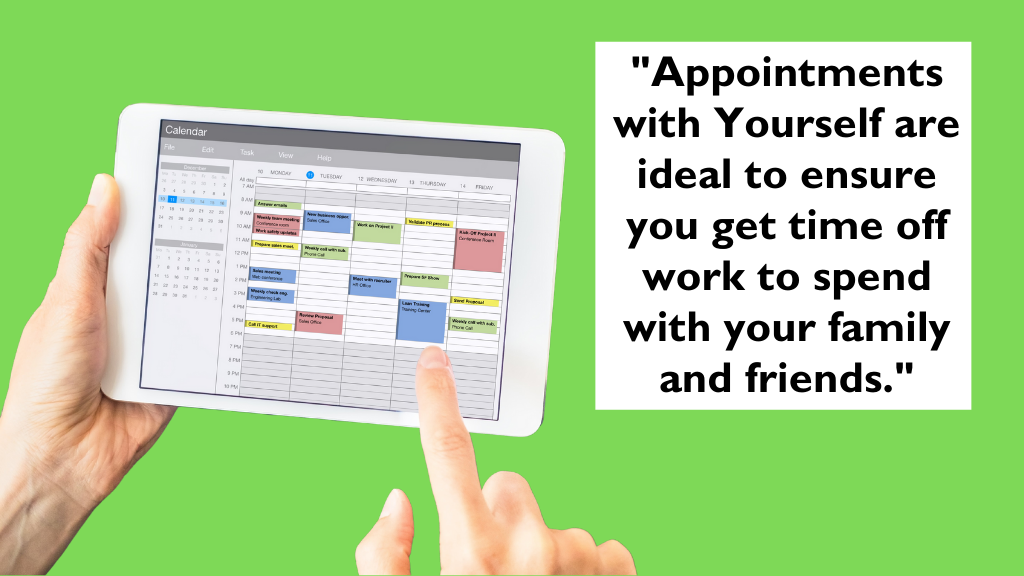
    In addition to work-based activities, Appointments with Yourself are ideal to ensure you get time off work to spend with your family and friends.

    For example, a regular date night with your spouse every Friday evening.

    Or your daughter Sally’s music recital on Thursday at 7:30 pm.

    Ask yourself, “How important are these events?” 

    If your answer isn’t ‘CRITICALLY FREAKING IMPORTANT,’ perhaps you should ask your child or spouse for a second opinion.

    Now, here (once again) is Rule #1 for Appointments with Yourself:

    Rule #1. Treat every Appointment with Yourself with the exact same respect that you would treat an appointment with your most important client.

    In other words, honour time with yourself and your family at least as much as you would honour time devoted to anyone else. This makes perfect sense, right?

    So, when your buyer client wants to look at properties on Thursday evening (the same night as Sally’s recital), here is your response:

    I’m sorry. I’m already booked solid on Thursday evening. Is there another day or time that would work for you?

    Simple. You don’t need to tell them it’s your daughter’s dance recital. That’s not their business. The only thing they need to know is that you’re booked up already.

    If you have trouble with this, we need to have a little talk. Call me right now – (403)973-9730.

    2. Get a Business Partner

    I know. I made that sound easy, right? Well, with the right person and a solid plan, it’s actually not hard to create a “loose” partnership.

    “Loose” means there is no formal agreement where you split commissions or expenses. Instead, I prefer to use a point system to keep track of who’s done what for each other. I’ve devised a simple system for this, but it’s too much for this blog post, so I’ll describe the Points Per Task system in more detail next week.

    Even though your loose partnership isn’t a formal arrangement, the public doesn’t need to know that. You could market yourselves as partners but still take care of your own clients 95% of the time. Here’s how I would explain the role of my business partner to my clients

    “If I’m ever not available, for any reason, my business partner will step in for me. I chose him because he’s extremely smart, and he approaches his business in the same way that I do, with the utmost integrity and 100% focused on providing the best possible experience for his clients and mine. I trust him implicitly.”

    I’ve never once explained this to a client and not had them respond with 100% positivity. In fact, if you are an individual agent, your availability is something that potential clients wonder about when choosing a REALTOR®, so it’s a huge plus to be able to say you have a backup, when needed.

    And, believe me, unlike the ridiculous amount of expectations that REALTORS® tend to apply to themselves…

    NOBODY ELSE expects you to be at their beck and call 24/7. 

    If they do, and you don’t feel like you can fire that client, give me a call. We need to have a little talk – 403-973-9730.

    Once you’ve got a partner, you need to meet regularly and keep each other informed about whatever you each have going on. For example, ask your partner to try to keep Thursday evening open if possible, in case something comes up while you’re at Sally’s recital.

    There’s much more to the “Loose Partnership” idea, so I’ll get into it more next week.For now, I suggest you go to your calendar, book an Appointment with Yourself, call your spouse, and ask them out on a date. ❤️

  • How to Become an Easy-Cool Prospect Pick-Up Artist (at Open Houses)

    How to Become an Easy-Cool Prospect Pick-Up Artist (at Open Houses)

    Last week, I introduced The Easy-Cool Prospect-to-Client Conversion Method. Here’s how it works in a real-world Open House situation:

    1. Prospects walk into the house. ‍♂️ ‍♀️
    2. Welcome them at the door with a warm smile, introduce yourself, and pause… 

    Most people will reciprocate and tell you their names. Their level of enthusiasm will be your first clue towards determining their communication style.

    1. Mentally note their names and likely communication style. After they’ve gone into the home, write their names, styles and brief description in your notebook. For example, “Big Nose Dan – Driver” and “Smiley Sue – Amiable.” 
    2. No matter which communication style you are working with, always balance the four key Relationship-Sales-Attributes: 

    Professionalism, Confidence, Friendliness, and Authenticity. 

    It’s not about merely possessing these attributes. It’s about finding the right level for each one and balancing them against each other. For example, a person can be overly friendly and totally unprofessional.

    1. Hand the prospects one of your stunning marketing brochures, and give them a brief overview of the property—price, key features, listing date, etc. The brochure is important. It shows off your marketing prowess and acts as a positive reminder about you after they leave.  

    Note: Only do this if you’re proud of your marketing brochure. If it’s just “average,” then “average” will be the impression you leave. 

    1. Send them through the house or continue the conversation, whichever is most appropriate, depending on their communication styles. Drivers and Analyticals will want to proceed into the house immediately. Expressives will want to enthusiastically tell you all about their day, while Amiables will be much quieter (but also the most open to making a sincere personal connection).
    2. Find the correct balance between their personal space (leave them alone) and your availability (I’m here to answer any questions you have!). If it’s a couple, they might have two different styles. That’s okay. You know how to juggle styles, right?
    3. When they’re done, address them by name and try to strike up a conversation without appearing too salesy. Make the conversation as natural as possible. Actively listen to them, but also slide in a few key questions. 

    So, Dan and Sue, how did you like the house? 

    Their answer should lead to other questions, such as:

    What are some important “wants and needs” you have for your new home? 

    What are your preferred areas? 

    How long have you been looking? 

    If you struggle to ask these questions and you sound fake and salesy, you’re doing it wrong.

    The answers, and more importantly, how they answer, will give you a huge amount of information to help you decide how to make your Prospect Pick-up Pitch.

    1. NEVER ask if they are working with an agent! That gives them an easy out. If they’re serious about the relationship they have with another agent, they’ll let you know.

    Maintain eye contact with them, and do NOT try to juggle three different groups at once. (You’ll lose all three. Once you have the right skills, you will know which prospects you need to focus on.)

    1. The Easy-Cool Prospect Pick-up Pitch:

    “Hey, I’m just thinking that I’ve got something that might be very helpful for you.” 

    (gets their attention).

    “It’s free, and there’s absolutely no obligation whatsoever.”

    (reduces resistance). 

    “Based on what you’ve told me, I can set you up on a system that will automatically send an email every time there’s a new listing that matches your exact search criteria.”

    (sounds great).

    “But here’s the really cool part. It will also automatically notify you whenever there is a price reduction or a sale, including the sale price.” 

    (even better).

    “It only takes me a few minutes to set this up, and as I said, there is no obligation whatsoever.” 

    (further reduces any sense of commitment).

    “Is this something that would be helpful for you?” 

    (of course, it is).

    “OK. All I need is both your email addresses, and I can set that up for you later today!

    1. After the Open House, set up the search and add them into your Follow-Up System (another topic). Remember, you said there was no obligation, and there isn’t. But that doesn’t mean you shouldn’t follow up appropriately and systematically. ☎️

    Of course, making this pitch doesn’t actually turn a prospect into a client. This is only the first step in that process. But maybe that’s my point: 

    When you try too hard, you turn people off. When you do it the Easy-Cool way (one step at a time), people are drawn to you naturally.

    Of course, you’re going to get all kinds of different responses to the pitch outlined above, but the main thing is to keep it Easy-Cool and come around to your Prospect Pick-up Pitch as naturally as possible. The better you get at it, the more successful you will become at converting prospects to clients.


    Are you reading this and saying to yourself, “I’ve tried this, and it doesn’t work”?

    THAT’S BECAUSE YOU’RE DOING IT WRONG.

    The two biggest mistakes I see REALTORS® make are:

    1. Trying too hard and coming across as annoying salesy types, or;
    2. Not trying at all! If this is you, honestly, you would be better off relaxing and recharging at home rather than wasting your time at an Open House where you’re not fully committed to putting in your best effort.

    Agents tell me all the time they never have any luck picking up clients at Open Houses. And yet, other agents (including myself back when I did Open Houses regularly) have no problems getting all the clients we want, practically at will—the Easy-Cool way.

    It’s got nothing to do with luck!

    Admittedly, you won’t become an Easy-Cool Prospect Pick-up Artist by merely reading this ultra-simplified three-minute blog post. I mean, there’s a TON of hints about different skills you need to acquire inside this post. For example, the Agent Skills Master’s Program has an entire module devoted to item #4 alone (Relationship Selling).

    But rather than feeling overwhelmed, just know this: ALL skills can be learned.

    You don’t need a coach. You need skills. Once you have them, they stay with you forever.

  • How to Double Your Success Rate with the ‘Easy-Cool’ Prospect-to-Client Conversion Method

    How to Double Your Success Rate with the ‘Easy-Cool’ Prospect-to-Client Conversion Method

    Do you ever meet people for the first time, hit it off immediately, and easily convert them to a client without even trying?

    It happens to ALL of us, sometimes. We happen to meet a kindred spirit, and we hit it off. There’s no actual skill to it.

    The skill comes in learning how to make these positive, honest connections more frequently with all different people, not just those we naturally connect with.

    I say ‘honest’ connections because learning to adapt your personality is not about faking it. On the contrary, it’s about delving deeper into your true self and allowing some of your less dominant personality traits to come to the surface. 

    Far from fakery, this is an enlightening experience that expands your personality and makes you more attractive to others, while remaining completely true to yourself.

    You’ll probably like yourself more, too!

    If you’ve ever wondered why certain agents seem to attract new clients practically at will, this is why. They’re just darn good at making personal connections. This valuable skill comes more naturally to some than others, but it’s a skill nonetheless, and all skills can be learned.

    It’s impossible to dive deep on such a massively important topic within the confines of a two-minute blog post, but here are a few hints:

    1. If you’re dealing with a Driver, and you’re not prompt, prepared, and straight-to-the-point, you will fail to make a connection.

    2. If you’re dealing with an Analytical and you speak loudly and fast-paced, you will fail to make a connection.

    3. If you’re dealing with an Amiable, and you’re all business, and you don’t take the time to get to know them on a personal level, you will fail to make a connection.

    4. If you’re dealing with an Expressive, and you’re slow-paced and quiet, you will fail to make a connection.

    These four points touch on the critically important topic of Communication Styles (module 7 in the Agent Skills Master’s Program). 

    In addition to learning more about Communication Styles, you also need to develop the correct balance of the four key attributes for REALTORS® – professionalism, confidence, authenticity, and friendliness – as taught in module 6 (Relationship Selling).

    Then, there’s The Follow-Up (module 4). Many agents are great at making a positive initial impression, but they drop the ball with The Follow-Up. What about you?

    The Easy-Cool Method

    The Easy-Cool Method utilizes all the skills above (and many others) to make honest, positive connections to a much wider scope of different people, more often and with far greater ease. When you have the right skills, making personal connections just comes naturally. 

    This is the same with all skills. Once you have them, you will reach a point of enlightenment where you use those skills without having to think about them, as if you’ve always had them. 

    As I discussed three weeks ago in Tiny Steps, you just need to take a first step. That could be taking the plunge and signing up for the Agent Skills Master’s Program, or taking a different course, or reading a book, or whatever.

    Next week I’ll talk about using the Easy-Cool Method in a specific situation – gathering contact information at an Open House.

  • The Simple Home Inspection Speech

    The Simple Home Inspection Speech

    You’ve worked with buyer clients Sam and Suzy for months and finally (!) found them what you think is their perfect new home. They were easy-going and fun to work with, and now all your hard work is about to pay off.

    You complete the home inspection, which turns up a typical list of minor stuff, and guess what happens?

    Sam and Suzy have gone all Jekyl and Hyde on you, and they’re now completely unreasonable! They’re focusing on tiny little things from the inspection and blowing everything completely out of proportion.

    You’re gobsmacked.

    The deal collapses, Sam and Suzy fire you because “you haven’t got their backs,” the other agent hates your guts.  After all those months of hard work, what do you get?

    Diddly-squat. 

    And, whose fault is it? Why, it’s your fault!

    Despite all that time you spent together with your buyer clients, you committed the sin of not setting proper expectations BEFORE the home inspection.

    Don’t forget, we do home inspections all the time, but Sam and Suzy may have never experienced one before.

    That’s why I’ve got a standard pre-inspection speech that I give every buyer client.

    Keep in mind; this speech is for my local market. Expectations may differ across North America, so take this with a grain of salt. Understand what is “normal” in your own market and modify your speech accordingly. 

    Also, despite whatever speech you devise for yourself, there are always variables regarding how you might approach the other side after a home inspection. These variables include fluctuating market conditions, your client’s communication style, and numerous other factors. Every situation is different, so I never recite my speech word for word. Instead, I modify it to suit the specific situation.

    One last caveat: As I explained last week in Why I Disregard the Advice of Lawyers, I always recommend one of my two favourite home inspectors to all my buyer clients, so that’s part of my speech. Here it is.

    “In my opinion, the inspectors I recommend are the two best in the city. I like them because they’re meticulous and never miss a thing, no matter how minor. Plus, they each provide a detailed report including pictures of every problem area or potential problem area. This report is so extensive, I usually recommend to my clients to keep it and think about it like a custom-designed homeowner’s manual that you’ll be able to reference for years to come.

    Now, even though I already know that they’re going to identify many minor problems, it’s important to understand that there is no such thing as a perfect home, and the purpose of the home inspection is not to make the seller fix every tiny, minor issue. 

    The real purpose is to discover if there are any unknown MAJOR problems that could be very expensive to remedy. In that case, we can try to renegotiate with the seller, or as a last resort, you will retain the right to walk away from the deal. Do you have any questions?” 

    Now, you can discuss the inspection further and lay out a few examples of what might be considered a major problem and how you might approach it. For example, in my market, if a roof is at the end of its life, it is not considered reasonable to expect the seller to pay for a brand new roof. However, a fair solution might be to split the cost.

    Do you see how having this conversation ahead of time sets up your client for success?

    We’ve all dealt with an inexperienced, unskilled REALTOR® on the other side of a transaction, who simply doesn’t know how to provide proper expectations, and they think their only role is to “follow their clients’ instructions.” Unfortunately, these agents don’t last long in this business.

    The same can be said for many different facets of our business. Simply laying out proper expectations ahead of time can save you huge amounts of headaches and blown-up deals later on.

    Great agents anticipate potential problems and set up solutions before they happen.

  • Why I (sometimes) Disregard the Advice of Lawyers

    Why I (sometimes) Disregard the Advice of Lawyers

    Disclaimer: Canadians are generally less litigious than our American cousins. If you are American, I suggest you take my advice with many grains of salt. And, whether you’re Canadian or American, use your own discretion and take personal responsibility for whatever calculated risks you choose to take on as part of your business. After all, no judge is ever going to let you off the hook just because, “Ted said so!”


    Every real estate lawyer will tell you that you should never recommend a single service provider. Their reasoning is simple and completely logical; If the person you recommend messes up, you could be held liable.

    This makes complete sense from a strictly legal perspective in terms of minimizing your personal liability. However, I consciously choose to disregard this sound legal advice.

    Using home inspectors as an example, I’ll explain why, but you could apply the same principles to any service provider you recommend, including lawyers! 


    Here’s the scenario: Your buyers have an accepted offer, conditional to a home inspection, and they’re asking for your advice on finding a good inspector. ️

    What are you supposed to do? Pretend you don’t know one? 

    If you can’t provide good advice to your clients when they need it, what good are you?

    Some lawyers recommend giving your clients a large list of potential service providers, but how is that limiting your liability? If any one of those inspectors messes up and a lawsuit ensues, did you not still explicitly recommend everyone on that list?

    I’d rather minimize the risk and recommend only one or two service providers that I trust to do a great job.


    First things first:

    If you recommend an inspector, you better make bloody damn sure they’re excellent at what they do. Here’s why I think my two inspectors are great:

    1. They’re consistently meticulous. They never miss even the tiniest detail, and they each provide excellent, extremely detailed PDF reports.
    2. They’re personable and customer-service-oriented. They know how to talk to people and patiently explain all the different components in their new home.
    3. They keep things in perspective. They don’t hide anything, but neither do they scare my clients into blowing up their deal over some insignificant, common problem.

    Here’s how I pitch my preferred inspectors to my buyer clients:

    “I’ve got two outstanding home inspectors I can recommend. They’re both meticulous, they never miss a thing, and after the inspection, they each provide an extremely detailed and informative report on your home, including pictures of every problem area. Honestly, in my opinion, these are probably the two best inspectors in the city. Would you like me to set this up for you?”

    At this point, hopefully, you’ve built a high level of trust and rapport with your clients, so allowing you to continue being in control of all the details is a no-brainer. After all, they probably know zero inspectors, and you know the two best ones in the city!

    I don’t remember the last time a client said, “no!” So, I make all the arrangements for them, setting up the day and time, etc.  

    This is infinitely better than having some unknown inspector come in and mess up your deal due to incompetence or stupidity, or both. This has happened to all of us, right?

    Why do I have two inspectors? Simple: if one of them is unavailable, I can always get the other one. It’s important not to put all your eggs in one basket. 

    Have I ever gotten myself in trouble by recommending a particular service provider?

    Never. Why? Because the people I recommend are the best at what they do. Therefore, I’m willing to accept the tiny risk that something might go wrong one day, because the benefits outweigh the risks by a long shot.

    The biggest benefit? My clients get a thorough understanding of exactly what they are buying. There are no surprises. 

    In my opinion, if you’re going to be a great REALTOR®, you must be willing to recommend expert service providers. Therefore, you must also be willing to accept some level of risk for the recommendations you make. The key is to minimize that risk by recommending only the best of the best.

    Next week, I’ll talk about properly establishing your clients’ expectations before the home inspection.

  • Tiny Steps

    Tiny Steps

    One Small Step Can Change Your Life – The Kaizen Way

    By Robert Maurer, Ph.D.

    A book review by Ted Greenhough

    I get many ideas from books, but this is the first time I’ve ever reviewed a book in the Real Agent Memo! I love this book because it’s tiny (2-3 hours to read), and the concepts are simple to understand. 

    It’s one thing to read a book and learn a lot. It’s quite another to easily implement the ideas into your life. But that’s the whole idea behind Kaizen – making things simple.

    When I first read the book, I realized that I knew many of the concepts instictively, and I’d been using them my entire life, but it was illuminating to understand why those things have worked for me. This gave me a well-needed shot in the arm, at a time when I felt like I was in a rut. It made the transition back to positivity and productivity incredibly simple. 

    When we feel overwhelmed, it’s good to remind ourselves of this familiar but powerful saying, “ A journey of a thousand miles must begin with the first step.” – Lao Tzu ‍♀️

    The book is based on the Japanese business philosophy of Kaizen, or continuous improvement. But it’s not just about business. The concepts can be applied to your personal life as well.

    The goals we all have, the pursuit of a rewarding personal relationship with another human being for example, or honouring and maintaining our personal health, can be elusive and even frightening at times. But for now, all you need to do is take one tiny step.

    Why Kaizen Works

    “All changes, even positive ones, are scary. Attempts to reach goals through radical or revolutionary means often fail because they heighten fear. But the small steps of kaizen disarm the brain’s fear response, stimulating rational thought and creative play.” — intro to Chapter One (Why Kaizen Works).

    The other chapters are: Ask Small Questions, Think Small Thoughts, Take Small Actions, Solve Small Problems, Bestow Small Rewards, Identify Small Moments, and Kaizen For Life.

    If you’re feeling overwhelmed, I encourage you to take one tiny step and buy this book.  Here are the links for Amazon in Canada, and Amazon in the U.S.A.

    When you receive the book, here’s one additional tiny step:

    Read the 14-page preface, beginning with “Change is hard!” After that, you’ll be hooked. Then you can decide for yourself your next tiny step.

    Be kind to yourself. Just take it one step at a time.