Category: Uncategorized

  • Two Solid Strategies to Create More Balance in Your Life

    Two Solid Strategies to Create More Balance in Your Life

    A great career AND time to enjoy the fruits of our labour; it’s what we all want, right? 

    Today is my 21st wedding anniversary, so in honour of my amazing wife – Michelle – here are two strategies I’ve implemented to create more time for her and our kids.

    1. Block off personal time.

    If you’ve been following me for a while, you’ve heard me talk about Appointments with Yourself before. Usually, it’s about productivity – creating time to study, work on a project, or any other important activity that requires your full attention.

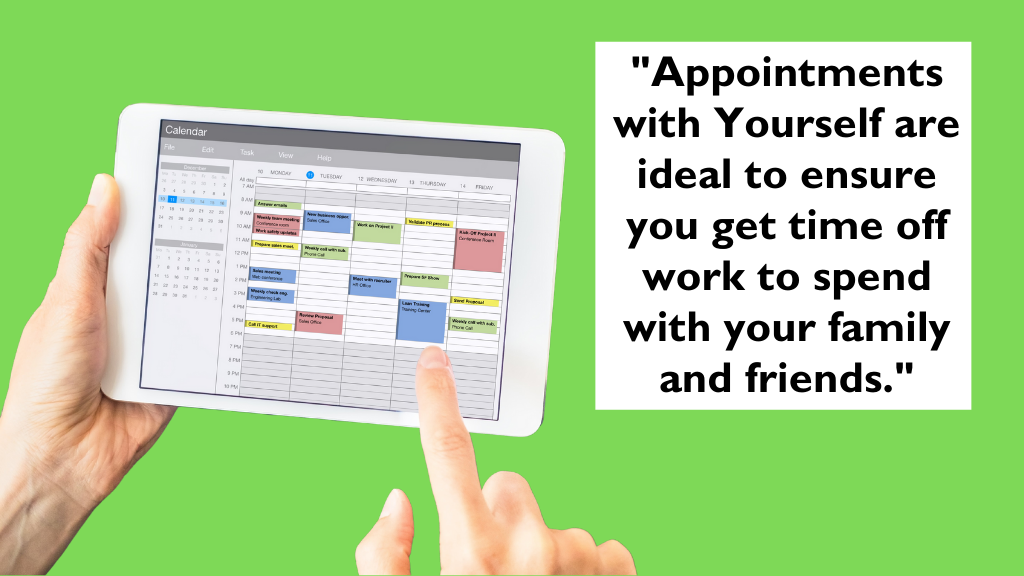
    In addition to work-based activities, Appointments with Yourself are ideal to ensure you get time off work to spend with your family and friends.

    For example, a regular date night with your spouse every Friday evening.

    Or your daughter Sally’s music recital on Thursday at 7:30 pm.

    Ask yourself, “How important are these events?” 

    If your answer isn’t ‘CRITICALLY FREAKING IMPORTANT,’ perhaps you should ask your child or spouse for a second opinion.

    Now, here (once again) is Rule #1 for Appointments with Yourself:

    Rule #1. Treat every Appointment with Yourself with the exact same respect that you would treat an appointment with your most important client.

    In other words, honour time with yourself and your family at least as much as you would honour time devoted to anyone else. This makes perfect sense, right?

    So, when your buyer client wants to look at properties on Thursday evening (the same night as Sally’s recital), here is your response:

    I’m sorry. I’m already booked solid on Thursday evening. Is there another day or time that would work for you?

    Simple. You don’t need to tell them it’s your daughter’s dance recital. That’s not their business. The only thing they need to know is that you’re booked up already.

    If you have trouble with this, we need to have a little talk. Call me right now – (403)973-9730.

    2. Get a Business Partner

    I know. I made that sound easy, right? Well, with the right person and a solid plan, it’s actually not hard to create a “loose” partnership.

    “Loose” means there is no formal agreement where you split commissions or expenses. Instead, I prefer to use a point system to keep track of who’s done what for each other. I’ve devised a simple system for this, but it’s too much for this blog post, so I’ll describe the Points Per Task system in more detail next week.

    Even though your loose partnership isn’t a formal arrangement, the public doesn’t need to know that. You could market yourselves as partners but still take care of your own clients 95% of the time. Here’s how I would explain the role of my business partner to my clients

    “If I’m ever not available, for any reason, my business partner will step in for me. I chose him because he’s extremely smart, and he approaches his business in the same way that I do, with the utmost integrity and 100% focused on providing the best possible experience for his clients and mine. I trust him implicitly.”

    I’ve never once explained this to a client and not had them respond with 100% positivity. In fact, if you are an individual agent, your availability is something that potential clients wonder about when choosing a REALTOR®, so it’s a huge plus to be able to say you have a backup, when needed.

    And, believe me, unlike the ridiculous amount of expectations that REALTORS® tend to apply to themselves…

    NOBODY ELSE expects you to be at their beck and call 24/7. 

    If they do, and you don’t feel like you can fire that client, give me a call. We need to have a little talk – 403-973-9730.

    Once you’ve got a partner, you need to meet regularly and keep each other informed about whatever you each have going on. For example, ask your partner to try to keep Thursday evening open if possible, in case something comes up while you’re at Sally’s recital.

    There’s much more to the “Loose Partnership” idea, so I’ll get into it more next week.For now, I suggest you go to your calendar, book an Appointment with Yourself, call your spouse, and ask them out on a date. ❤️

  • How to Become an Easy-Cool Prospect Pick-Up Artist (at Open Houses)

    How to Become an Easy-Cool Prospect Pick-Up Artist (at Open Houses)

    Last week, I introduced The Easy-Cool Prospect-to-Client Conversion Method. Here’s how it works in a real-world Open House situation:

    1. Prospects walk into the house. ‍♂️ ‍♀️
    2. Welcome them at the door with a warm smile, introduce yourself, and pause… 

    Most people will reciprocate and tell you their names. Their level of enthusiasm will be your first clue towards determining their communication style.

    1. Mentally note their names and likely communication style. After they’ve gone into the home, write their names, styles and brief description in your notebook. For example, “Big Nose Dan – Driver” and “Smiley Sue – Amiable.” 
    2. No matter which communication style you are working with, always balance the four key Relationship-Sales-Attributes: 

    Professionalism, Confidence, Friendliness, and Authenticity. 

    It’s not about merely possessing these attributes. It’s about finding the right level for each one and balancing them against each other. For example, a person can be overly friendly and totally unprofessional.

    1. Hand the prospects one of your stunning marketing brochures, and give them a brief overview of the property—price, key features, listing date, etc. The brochure is important. It shows off your marketing prowess and acts as a positive reminder about you after they leave.  

    Note: Only do this if you’re proud of your marketing brochure. If it’s just “average,” then “average” will be the impression you leave. 

    1. Send them through the house or continue the conversation, whichever is most appropriate, depending on their communication styles. Drivers and Analyticals will want to proceed into the house immediately. Expressives will want to enthusiastically tell you all about their day, while Amiables will be much quieter (but also the most open to making a sincere personal connection).
    2. Find the correct balance between their personal space (leave them alone) and your availability (I’m here to answer any questions you have!). If it’s a couple, they might have two different styles. That’s okay. You know how to juggle styles, right?
    3. When they’re done, address them by name and try to strike up a conversation without appearing too salesy. Make the conversation as natural as possible. Actively listen to them, but also slide in a few key questions. 

    So, Dan and Sue, how did you like the house? 

    Their answer should lead to other questions, such as:

    What are some important “wants and needs” you have for your new home? 

    What are your preferred areas? 

    How long have you been looking? 

    If you struggle to ask these questions and you sound fake and salesy, you’re doing it wrong.

    The answers, and more importantly, how they answer, will give you a huge amount of information to help you decide how to make your Prospect Pick-up Pitch.

    1. NEVER ask if they are working with an agent! That gives them an easy out. If they’re serious about the relationship they have with another agent, they’ll let you know.

    Maintain eye contact with them, and do NOT try to juggle three different groups at once. (You’ll lose all three. Once you have the right skills, you will know which prospects you need to focus on.)

    1. The Easy-Cool Prospect Pick-up Pitch:

    “Hey, I’m just thinking that I’ve got something that might be very helpful for you.” 

    (gets their attention).

    “It’s free, and there’s absolutely no obligation whatsoever.”

    (reduces resistance). 

    “Based on what you’ve told me, I can set you up on a system that will automatically send an email every time there’s a new listing that matches your exact search criteria.”

    (sounds great).

    “But here’s the really cool part. It will also automatically notify you whenever there is a price reduction or a sale, including the sale price.” 

    (even better).

    “It only takes me a few minutes to set this up, and as I said, there is no obligation whatsoever.” 

    (further reduces any sense of commitment).

    “Is this something that would be helpful for you?” 

    (of course, it is).

    “OK. All I need is both your email addresses, and I can set that up for you later today!

    1. After the Open House, set up the search and add them into your Follow-Up System (another topic). Remember, you said there was no obligation, and there isn’t. But that doesn’t mean you shouldn’t follow up appropriately and systematically. ☎️

    Of course, making this pitch doesn’t actually turn a prospect into a client. This is only the first step in that process. But maybe that’s my point: 

    When you try too hard, you turn people off. When you do it the Easy-Cool way (one step at a time), people are drawn to you naturally.

    Of course, you’re going to get all kinds of different responses to the pitch outlined above, but the main thing is to keep it Easy-Cool and come around to your Prospect Pick-up Pitch as naturally as possible. The better you get at it, the more successful you will become at converting prospects to clients.


    Are you reading this and saying to yourself, “I’ve tried this, and it doesn’t work”?

    THAT’S BECAUSE YOU’RE DOING IT WRONG.

    The two biggest mistakes I see REALTORS® make are:

    1. Trying too hard and coming across as annoying salesy types, or;
    2. Not trying at all! If this is you, honestly, you would be better off relaxing and recharging at home rather than wasting your time at an Open House where you’re not fully committed to putting in your best effort.

    Agents tell me all the time they never have any luck picking up clients at Open Houses. And yet, other agents (including myself back when I did Open Houses regularly) have no problems getting all the clients we want, practically at will—the Easy-Cool way.

    It’s got nothing to do with luck!

    Admittedly, you won’t become an Easy-Cool Prospect Pick-up Artist by merely reading this ultra-simplified three-minute blog post. I mean, there’s a TON of hints about different skills you need to acquire inside this post. For example, the Agent Skills Master’s Program has an entire module devoted to item #4 alone (Relationship Selling).

    But rather than feeling overwhelmed, just know this: ALL skills can be learned.

    You don’t need a coach. You need skills. Once you have them, they stay with you forever.

  • How to Double Your Success Rate with the ‘Easy-Cool’ Prospect-to-Client Conversion Method

    How to Double Your Success Rate with the ‘Easy-Cool’ Prospect-to-Client Conversion Method

    Do you ever meet people for the first time, hit it off immediately, and easily convert them to a client without even trying?

    It happens to ALL of us, sometimes. We happen to meet a kindred spirit, and we hit it off. There’s no actual skill to it.

    The skill comes in learning how to make these positive, honest connections more frequently with all different people, not just those we naturally connect with.

    I say ‘honest’ connections because learning to adapt your personality is not about faking it. On the contrary, it’s about delving deeper into your true self and allowing some of your less dominant personality traits to come to the surface. 

    Far from fakery, this is an enlightening experience that expands your personality and makes you more attractive to others, while remaining completely true to yourself.

    You’ll probably like yourself more, too!

    If you’ve ever wondered why certain agents seem to attract new clients practically at will, this is why. They’re just darn good at making personal connections. This valuable skill comes more naturally to some than others, but it’s a skill nonetheless, and all skills can be learned.

    It’s impossible to dive deep on such a massively important topic within the confines of a two-minute blog post, but here are a few hints:

    1. If you’re dealing with a Driver, and you’re not prompt, prepared, and straight-to-the-point, you will fail to make a connection.

    2. If you’re dealing with an Analytical and you speak loudly and fast-paced, you will fail to make a connection.

    3. If you’re dealing with an Amiable, and you’re all business, and you don’t take the time to get to know them on a personal level, you will fail to make a connection.

    4. If you’re dealing with an Expressive, and you’re slow-paced and quiet, you will fail to make a connection.

    These four points touch on the critically important topic of Communication Styles (module 7 in the Agent Skills Master’s Program). 

    In addition to learning more about Communication Styles, you also need to develop the correct balance of the four key attributes for REALTORS® – professionalism, confidence, authenticity, and friendliness – as taught in module 6 (Relationship Selling).

    Then, there’s The Follow-Up (module 4). Many agents are great at making a positive initial impression, but they drop the ball with The Follow-Up. What about you?

    The Easy-Cool Method

    The Easy-Cool Method utilizes all the skills above (and many others) to make honest, positive connections to a much wider scope of different people, more often and with far greater ease. When you have the right skills, making personal connections just comes naturally. 

    This is the same with all skills. Once you have them, you will reach a point of enlightenment where you use those skills without having to think about them, as if you’ve always had them. 

    As I discussed three weeks ago in Tiny Steps, you just need to take a first step. That could be taking the plunge and signing up for the Agent Skills Master’s Program, or taking a different course, or reading a book, or whatever.

    Next week I’ll talk about using the Easy-Cool Method in a specific situation – gathering contact information at an Open House.

  • The Simple Home Inspection Speech

    The Simple Home Inspection Speech

    You’ve worked with buyer clients Sam and Suzy for months and finally (!) found them what you think is their perfect new home. They were easy-going and fun to work with, and now all your hard work is about to pay off.

    You complete the home inspection, which turns up a typical list of minor stuff, and guess what happens?

    Sam and Suzy have gone all Jekyl and Hyde on you, and they’re now completely unreasonable! They’re focusing on tiny little things from the inspection and blowing everything completely out of proportion.

    You’re gobsmacked.

    The deal collapses, Sam and Suzy fire you because “you haven’t got their backs,” the other agent hates your guts.  After all those months of hard work, what do you get?

    Diddly-squat. 

    And, whose fault is it? Why, it’s your fault!

    Despite all that time you spent together with your buyer clients, you committed the sin of not setting proper expectations BEFORE the home inspection.

    Don’t forget, we do home inspections all the time, but Sam and Suzy may have never experienced one before.

    That’s why I’ve got a standard pre-inspection speech that I give every buyer client.

    Keep in mind; this speech is for my local market. Expectations may differ across North America, so take this with a grain of salt. Understand what is “normal” in your own market and modify your speech accordingly. 

    Also, despite whatever speech you devise for yourself, there are always variables regarding how you might approach the other side after a home inspection. These variables include fluctuating market conditions, your client’s communication style, and numerous other factors. Every situation is different, so I never recite my speech word for word. Instead, I modify it to suit the specific situation.

    One last caveat: As I explained last week in Why I Disregard the Advice of Lawyers, I always recommend one of my two favourite home inspectors to all my buyer clients, so that’s part of my speech. Here it is.

    “In my opinion, the inspectors I recommend are the two best in the city. I like them because they’re meticulous and never miss a thing, no matter how minor. Plus, they each provide a detailed report including pictures of every problem area or potential problem area. This report is so extensive, I usually recommend to my clients to keep it and think about it like a custom-designed homeowner’s manual that you’ll be able to reference for years to come.

    Now, even though I already know that they’re going to identify many minor problems, it’s important to understand that there is no such thing as a perfect home, and the purpose of the home inspection is not to make the seller fix every tiny, minor issue. 

    The real purpose is to discover if there are any unknown MAJOR problems that could be very expensive to remedy. In that case, we can try to renegotiate with the seller, or as a last resort, you will retain the right to walk away from the deal. Do you have any questions?” 

    Now, you can discuss the inspection further and lay out a few examples of what might be considered a major problem and how you might approach it. For example, in my market, if a roof is at the end of its life, it is not considered reasonable to expect the seller to pay for a brand new roof. However, a fair solution might be to split the cost.

    Do you see how having this conversation ahead of time sets up your client for success?

    We’ve all dealt with an inexperienced, unskilled REALTOR® on the other side of a transaction, who simply doesn’t know how to provide proper expectations, and they think their only role is to “follow their clients’ instructions.” Unfortunately, these agents don’t last long in this business.

    The same can be said for many different facets of our business. Simply laying out proper expectations ahead of time can save you huge amounts of headaches and blown-up deals later on.

    Great agents anticipate potential problems and set up solutions before they happen.

  • Why I (sometimes) Disregard the Advice of Lawyers

    Why I (sometimes) Disregard the Advice of Lawyers

    Disclaimer: Canadians are generally less litigious than our American cousins. If you are American, I suggest you take my advice with many grains of salt. And, whether you’re Canadian or American, use your own discretion and take personal responsibility for whatever calculated risks you choose to take on as part of your business. After all, no judge is ever going to let you off the hook just because, “Ted said so!”


    Every real estate lawyer will tell you that you should never recommend a single service provider. Their reasoning is simple and completely logical; If the person you recommend messes up, you could be held liable.

    This makes complete sense from a strictly legal perspective in terms of minimizing your personal liability. However, I consciously choose to disregard this sound legal advice.

    Using home inspectors as an example, I’ll explain why, but you could apply the same principles to any service provider you recommend, including lawyers! 


    Here’s the scenario: Your buyers have an accepted offer, conditional to a home inspection, and they’re asking for your advice on finding a good inspector. ️

    What are you supposed to do? Pretend you don’t know one? 

    If you can’t provide good advice to your clients when they need it, what good are you?

    Some lawyers recommend giving your clients a large list of potential service providers, but how is that limiting your liability? If any one of those inspectors messes up and a lawsuit ensues, did you not still explicitly recommend everyone on that list?

    I’d rather minimize the risk and recommend only one or two service providers that I trust to do a great job.


    First things first:

    If you recommend an inspector, you better make bloody damn sure they’re excellent at what they do. Here’s why I think my two inspectors are great:

    1. They’re consistently meticulous. They never miss even the tiniest detail, and they each provide excellent, extremely detailed PDF reports.
    2. They’re personable and customer-service-oriented. They know how to talk to people and patiently explain all the different components in their new home.
    3. They keep things in perspective. They don’t hide anything, but neither do they scare my clients into blowing up their deal over some insignificant, common problem.

    Here’s how I pitch my preferred inspectors to my buyer clients:

    “I’ve got two outstanding home inspectors I can recommend. They’re both meticulous, they never miss a thing, and after the inspection, they each provide an extremely detailed and informative report on your home, including pictures of every problem area. Honestly, in my opinion, these are probably the two best inspectors in the city. Would you like me to set this up for you?”

    At this point, hopefully, you’ve built a high level of trust and rapport with your clients, so allowing you to continue being in control of all the details is a no-brainer. After all, they probably know zero inspectors, and you know the two best ones in the city!

    I don’t remember the last time a client said, “no!” So, I make all the arrangements for them, setting up the day and time, etc.  

    This is infinitely better than having some unknown inspector come in and mess up your deal due to incompetence or stupidity, or both. This has happened to all of us, right?

    Why do I have two inspectors? Simple: if one of them is unavailable, I can always get the other one. It’s important not to put all your eggs in one basket. 

    Have I ever gotten myself in trouble by recommending a particular service provider?

    Never. Why? Because the people I recommend are the best at what they do. Therefore, I’m willing to accept the tiny risk that something might go wrong one day, because the benefits outweigh the risks by a long shot.

    The biggest benefit? My clients get a thorough understanding of exactly what they are buying. There are no surprises. 

    In my opinion, if you’re going to be a great REALTOR®, you must be willing to recommend expert service providers. Therefore, you must also be willing to accept some level of risk for the recommendations you make. The key is to minimize that risk by recommending only the best of the best.

    Next week, I’ll talk about properly establishing your clients’ expectations before the home inspection.

  • Tiny Steps

    Tiny Steps

    One Small Step Can Change Your Life – The Kaizen Way

    By Robert Maurer, Ph.D.

    A book review by Ted Greenhough

    I get many ideas from books, but this is the first time I’ve ever reviewed a book in the Real Agent Memo! I love this book because it’s tiny (2-3 hours to read), and the concepts are simple to understand. 

    It’s one thing to read a book and learn a lot. It’s quite another to easily implement the ideas into your life. But that’s the whole idea behind Kaizen – making things simple.

    When I first read the book, I realized that I knew many of the concepts instictively, and I’d been using them my entire life, but it was illuminating to understand why those things have worked for me. This gave me a well-needed shot in the arm, at a time when I felt like I was in a rut. It made the transition back to positivity and productivity incredibly simple. 

    When we feel overwhelmed, it’s good to remind ourselves of this familiar but powerful saying, “ A journey of a thousand miles must begin with the first step.” – Lao Tzu ‍♀️

    The book is based on the Japanese business philosophy of Kaizen, or continuous improvement. But it’s not just about business. The concepts can be applied to your personal life as well.

    The goals we all have, the pursuit of a rewarding personal relationship with another human being for example, or honouring and maintaining our personal health, can be elusive and even frightening at times. But for now, all you need to do is take one tiny step.

    Why Kaizen Works

    “All changes, even positive ones, are scary. Attempts to reach goals through radical or revolutionary means often fail because they heighten fear. But the small steps of kaizen disarm the brain’s fear response, stimulating rational thought and creative play.” — intro to Chapter One (Why Kaizen Works).

    The other chapters are: Ask Small Questions, Think Small Thoughts, Take Small Actions, Solve Small Problems, Bestow Small Rewards, Identify Small Moments, and Kaizen For Life.

    If you’re feeling overwhelmed, I encourage you to take one tiny step and buy this book.  Here are the links for Amazon in Canada, and Amazon in the U.S.A.

    When you receive the book, here’s one additional tiny step:

    Read the 14-page preface, beginning with “Change is hard!” After that, you’ll be hooked. Then you can decide for yourself your next tiny step.

    Be kind to yourself. Just take it one step at a time.

  • The FSBO Rant

    The FSBO Rant

    Bob: Hey, Dan. I saved $15,000 on a lawyer by representing myself!

    Dan: Good for you! Let’s go out and celebrate!

    Bob: OK, but can you wait two years? I’m in jail right now.


    You’ve heard the ads.

    “Jonny hired ‘FSBO Inc’ and saved over $15,000!”

     Really? How does Johnny know he saved $15,000? How does he know he didn’t actually lose money by choosing not to hire an experienced, highly skilled agent?

    Answer: Johnny doesn’t know, and he’ll never know because he’s already sold his home to some lucky buyer who cashed in on his massive naivety.

    You’re a professional REALTOR®, so you know exactly what I’m talking about, right? 

    But how do we explain this to the public?

    How about simply telling them the straight-up truth?

    (Note: You might need to tone down my snarkiness a smidge.)

    The straight-up truth about FSBO, Inc:

    1. They claim you’re going to get “professional representation” to help with all the paperwork, marketing, negotiating, etc. Ask yourself one simple question: If these people were actually good at what they do, why are they working for peanuts for ‘FSBO Inc’? 

    2. When it comes to negotiating, you’re on your own (see #1 above). So, how do you think you’re going to fare negotiating your first real estate transaction against a shark who does this for a living? 

    3. Despite the “rules,” most agents will avoid showing your property and will discourage buyers from writing an offer on it. Why?

    First, there’s a high probability that it’s overpriced, based on the combination of the terrible advice you’ve received from the FSBO “agent” and your own “feelings” about what your home is worth.

    Second, every professional REALTOR® knows that working directly with a FSBO seller is likely to be a painful experience compared to dealing with a professional. It’s usually twice as much work and three times as much stress. 

    Third, there are additional legal liability concerns because a FSBO is simply not held to the same reporting and disclosure standards compared to a professional real estate brokerage.

    4. You really have no choice but to pay the buyer’s side of the commission anyway (you already know how to explain this.) On top of that, there are listing costs from ‘FSBO, Inc’ that need to be paid up-front, whether you sell or not. So tell me again, how much are you going to “save”? 

    5. Quality of Buyers – There are three types of buyers. (1) Potential Buyers – anyone who wants to buy a home, (2) Qualified Buyers – those who have the ability to buy a home, and, (3) Serious Buyers – those who are actively looking to buy a home. 

    But the ONLY buyers who matter are both (2) qualified and (3) serious. You can have a serious buyer who isn’t qualified, or a qualified buyer who isn’t serious, right? So, guess what? 

    Almost ALL serious, qualified buyers are working with a professional real estate agent – the ones who want to avoid showing your FSBO! 

    The people who call you directly? Those are potential buyers, but are they qualified? Are they serious? How will you know? Have fun showing your home to a bunch of looky-loos who have no intention of ever buying.

    Let’s expand on this and look at serious, qualified buyers from a different perspective. All of the following buyers are both serious and qualified:

    ‘A’ Buyers 

    ‘A’ Buyers are every REALTOR®’s dream client. They’re getting transferred from a city where prices are significantly higher than in your market. For me (Calgary), this could mean they’re coming from Toronto or Vancouver. If you’re in one of those cities, maybe your buyer is international, Hong Kong or New York, for example. 

    These buyers are moving to your market area because they’re probably getting a promotion/raise, and they’ve got a pocket full of cash, having just sold their home in (expensive city). They’re working with a highly qualified agent referred by their trusted local agent, and they’re flying in on the weekend to look at ten homes and choose the best one.

    They can’t believe the “bargains” in your city! But guess what? The REALTOR® wants to make the most of the short time they have together, so they’re not going to waste valuable time looking at FSBOs.

    No ‘A’ buyers for you!

    ‘B’ Buyers

    These buyers are local, but they’ve just sold their existing home. They’ve got a short window of opportunity to find their new home, and they’ve already developed trust and rapport with their agent, so guess what? This agent isn’t going to waste time with their valuable repeat-business clients looking at FSBOs.

    No ‘B’ buyers for you! 

    ‘C’ Buyers 

    These are first-time buyers. They’re scared, and they don’t know the process. They were referred to their agent by their parents or someone else they trust. The agent takes this responsibility seriously and will not risk getting into a messy deal with a FSBO. 

    No ‘C’ buyers for you!

    ‘D’ Buyers 

    These are bargain hunters and investors. They know the market, and they’re looking for people selling undervalue. They LOVE ❤️working with FSBOs!

    Congratulations! You get all the ‘D’ buyers!

    You still think you “saved” $15,000, Johnny?


    (Thanks to my friend Pete for this simple A/B/C/D presentation. He does it on a whiteboard, overflowing with confidence, and he’s never once in his entire career NOT successfully converted a FSBO back to their senses.

    Honestly, despite my snarkiness oozing in this article, the truth is:

    I feel sorry for FSBOs.

    I mean, how are they supposed to know, if you don’t explain it to them?

    I completely understand how people can conclude that FSBO is the way to go, if they’ve had one or more bad experiences with an unskilled, unprofessional, apathetic agent, which—let’s be honest—is not a rarity.

    These agents are the seagulls of the bird world – obnoxiously loud, squawking scavengers who serve no useful purpose, at least to the untrained ornithological eye. I’m sure seagulls are good for something (?).

    No wonder people turn to FSBO Companies. They think we’re ALL seagulls.

    Are you a seagull? Or are you an eagle?

    Be an eagle. If we were all eagles, ‘FSBO Inc’ would not even exist.


    Disclaimer: The Agent Skills Master’s Program contains NOTHING about FSBOs in the entire course. I’ll fix that with the next update, but here’s why it never occurred to me to include it the first time around:

    I always knew how to demonstrate my value. As a result, I attracted high-quality clients who trusted me as a professional and would never even consider selling their own home, or represent themselves in court, for that matter. 

    If you really want to convince people not to go FSBO, demonstrate your value with actions, not words. It’s not as difficult as it sounds.

    Be an eagle.

  • Business and Friendships

    Business and Friendships

    Meeting and connecting with all different people is a big part of what makes real estate fun.

    This has nothing to do with being introverted or extroverted. Introverts may be less comfortable in a big crowd (at a party, for example), but they can be masterful at connecting one-on-one. 

    The key thing is that you enjoy people – all kinds of people – and you’re open to learning from them. What makes them happy? What is important to them? What good things are happening in their lives, and what are some of their challenges?

    If you have the attitude that you can connect with and learn from almost anyone, and you have the ability to apply what you‘ve learned, you’re going to be a success.

    But even though we should all try to grow and become better at whatever we do, and a lot of that growth comes from our personal interactions, there’s more to life than just personal growth. Sometimes we just need to stop and enjoy what we have.

    Unless you’re a psychopath or a narcissist (or both!), the personal connections you make during your short time on this earth are what make life worth living. The more true friendships you have, the happier and more satisfied you will be.

    If you value personal relationships and you want to connect more with people, sometimes you need to stop being a REALTOR® for a while. Take the time to enjoy having a normal conversation that has nothing to do with real estate and build your personal connections.


    Do you ever feel regret at the end of a business transaction that you’re not going to get to spend time with your new “friends” any longer?

    If you feel that way, they probably do too. So how do you go about converting a business relationship into an ongoing friendship?

    It’s easier than you think, but someone has to make the first move. Here’s a simple suggestion:

    Invite them to your home for dinner. This is more personal and meaningful than just meeting at a restaurant. Maybe you invite another couple you think they will like, also. Make a night of it!

    If you’re worried about this being too weird, use the excuse that it’s a thing you do for your favorite clients to show appreciation for their business. After all, if you feel an affinity towards them, they’re feeling it too, and they’re going to truly appreciate the opportunity to get to know you on a personal level after business has concluded. 

    This could be the first step towards a lifelong friendship!

    I tell you this with regret in my heart ❤️ that nobody ever suggested it to me.  I’ve made so many close personal connections to clients over the years that never ended up going anywhere. Why? Because I was too shy to pursue the relationship outside of the confines of business.

    I wish I had.   

    After all, life is so much more than how many transactions you completed last year. If you can find a way to combine business with pleasure, why not?

  • Three Options for Agents who Don’t Want to Run a Business

    Three Options for Agents who Don’t Want to Run a Business

    Does this describe you?

    “I didn’t get into real estate to run a business. I got into it to make money and have fun and wield my skills and talents. I just want to sell my craft and not worry about the business end of things – It’s too hard, it takes too much time, and it’s just too heavy.”

    I totally understand. Honest. 

    And, I have three possible solutions. Pick the one that works for you:

    1. Join a team! 

    The team is a business, but they take care of all that yucky stuff you hate. That sounds good, right? But nothing in this world is free.

    The biggest trade-off is making less money. But perhaps even more importantly, you will now have significantly less freedom. Now, you need to follow the team leader’s orders, including learning cheesy scripts, chasing crappy leads, and working the phones for hours every day. 

    If this appeals to you, I have no idea what brought you to read this blog post because I just described the antithesis of Agent Skills.

    To be fair, there are many different team models, including small customer-service-focused teams with support staff – including a business manager – where you might be very happy. This could be worth exploring if this concept appeals to you.

    2. Do nothing!

    Choosing to do nothing is a choice unto itself.

    You get up every day, you react as best as you can to whatever is going on, you go to bed, and then you get up and do it all over again. 

    You’re doing okay, right? Maybe you’re not the most organized person in the world, but the deals come together, and you’re making a decent living, right?

    No? ☹️

    Hey, if you’re not satisfied with your career and you don’t want to join a team, you still have one last option:

    3. Quit yer bawlin’!

    Sorry! Not sorry! It’s all in your head that the business end of real estate is so excruciating. Learning a few business skills makes your life massively easier—not harder! When you have business skills, your life is more fun, not less fun!

    Face the facts. If you want real success in real estate, you have to put on your big-girl panties and learn some basic business skills.

    The more you learn, the more money you will make (and keep), and eventually, you’ll have your own full-time all-star assistant who can take care of all the mundane tasks you hate doing and free up your time to make even more money.

    In the meantime, you don’t have to do everything yourself! In fact, I recommend against doing the things that you hate, especially if they’re not directly related to making money. But you can’t just ignore those things; you need to hire them out to the right people. This is an important part of being an effective business manager.

    Learning how to get more done, more effectively, in less time, requires hard work, sacrifice, and taking on some things you’re not thrilled about. For now. 

    This is the cold hard truth for every single successful business person who has ever lived.

    So, quit yer bawlin’. Learn some skills, implement them, and watch your business grow! The time you invest now will pay off for you a hundred times over in the future.

  • How to Stop Being Late for Everything

    How to Stop Being Late for Everything

    Are you a time-optimist? ⏱️

    A time-optimist is a person who always thinks they can fit in one more thing, or they allow just enough time to get things done under ideal circumstances. 

    In other words, they’re late for everything.

    They always have an excuse which they breathlessly explain immediately upon arrival. Once you get to know the time-optimist, it’s sort of a game to guess what excuse they will use this time.

    Me? I’m early for everything, which means I’m a time-pessimist. I worry about being late. 

    To me, being late goes hand-in-hand with being disorganized and ineffective. Let’s look at a simple example to illustrate what I mean:


    Me (a time-pessimist) and Otis (a time-optimist) both have listing appointments at 3:00 pm this afternoon. Coincidentally, the properties are side by side.

    I completed my initial CMA two days ago, fine-tuned it yesterday at 10:30 am, and reviewed it again today at 2:00 pm, an hour before my appointment. These events didn’t happen by fluke or because I’ve got more time to burn than Otis has. On the contrary, I’m far busier than Otis is, but I run my life by controlling my calendar. 

    I purposely scheduled ‘Appointments with Myself’ to ensure each step of my CMA process – including the fine-tuning session and final review – got completed on time.

    My listing appointment is only 15 minutes away, but I leave at 2:30, just in case there’s heavy traffic or something else goes wrong.

    I sail straight there and arrive early at 2:45. No problem. I park down the street and quickly review my CMA one more time. I’m feeling very confident with it, so I use the remaining extra time to check and respond to my messages.

    Deliberately allowing extra time between appointments is one reason I’m always on top of everything. After all, I can run my entire life off my smartphone. Can’t you?

    At 2:55, I drive up to the house, park in the driveway, and quickly review my notes one last time before ringing the doorbell at precisely 3:00 pm. I go in, nail it, and walk out with the signed listing contract.

    During that appointment, a funny thing happens. At around 3:07, I hear a car screeching to a stop outside, followed by a door-slam and rapid-fire footsteps.

    That was Otis showing up seven minutes late. He left his office “on time” at 2:45, but apparently, he hit every red light on the way. That was his excuse this time. He uses that one quite frequently, now that I think about it. 

    As always, Otis has been super busy, so he never got around to starting his CMA until 2:00 pm (actually, it was 2:11). On the way over, he glanced over his CMA at the red lights, realized he messed it all up, and ended up stumbling through his presentation and not making much of an impression. 

    It turns out he’d already lost the listing at 3:05 anyway, before he even got there. Why? 

    Because his potential client was a time-pessimist (like me), and she was incensed that Otis would show up late for such an important meeting.

    If you’re a time-optimist, know this: Time-pessimists don’t buy into your feeble excuses for always being late. We see this as a weakness of character and completely disrespectful of our time. After all, we make sure we’re on time for appointments. Why can’t you?


    Let’s take a look at why Otis’s life is so hectic. Is he just plain way busier than me? It sure seems that way.

    Nope! In fact, I’m doing three times the volume of business compared to Otis. There are numerous reasons for this, but I’ll tell you one of the most important:

    I’m not a time-optimist.

    If you are one, it’s time to get more pessimistic (about time)!

    This is a massive topic that’s not going to get resolved by reading a three-minute blog post. But here’s a hot tip to get you started:

    Stop trying to be on time, and start planning (using your calendar) to be 15 minutes early. Just try it for one week, and then tell me you aren’t far more efficient and organized.

    A 15-minute time shift can completely change your life.


    A personal note from Ted: I’m a natural-born optimist about most things, but when it comes to time, I’m a pessimist. It’s basically part of my DNA to fret over being late, which I’m grateful for.

    But being a time-pessimist doesn’t mean I’m a naturally organized person. In fact, I’ve got a not-so-mild form of ADHD, and I’ve had to learn skills to overcome this. Otherwise, I’d be a total mess.

    The point is if you’re a time-optimist, and you think there’s nothing you can do about it, stop fooling yourself. The skills you need to stop feeling so out of control and behind all the time are entirely learnable.